
Spend twenty-five years managing commercial territory and you learn that you cannot secure an account from a spreadsheet fifty miles away. The reps who lose their shirt are always the ones who stay inside the office, send emails, and assume the territory is holding together on its own. Look at how most modern neighborhoods operate at five o’clock on a Tuesday. A man pulls into his driveway, hits the remote on the visor, rolls straight into the garage, and drops the steel door behind him before his boots even touch the concrete. He lives thirty feet from the guy next door and could not tell you if that neighbor lost his job last week or put his wife in the hospital this morning.
A man who treats his own house like a bunker has already surrendered the street outside his window.
The Blueprint: The Watchman on the Wall and the Front Porch
When Nehemiah rebuilt the shattered perimeter of Jerusalem, he did not let each family retreat inside their own four walls and hope for the best. In Nehemiah 4:14, he looked at the leaders and the rest of the people and gave them a direct order: “Do not be afraid of them. Remember the Lord, who is great and awesome, and fight for your families, your sons and your daughters, your wives and your homes.” He stationed each household on the stretch of wall directly in front of their own house so everyone had eyes on the street.
Drive into almost any small American town built before the interstate era and you will see that exact physical logic laid out in brick and stone. Main Street was never designed by a distant planning committee. It grew as a compact civic machine where commerce, law, faith, and daily accountability all happened within shouting distance:
- The Brick-and-Mortar Ledger: The bank sat near the center in solid brick or stone so people knew their savings could survive a storm. The courthouse sat back with a lawn for public gatherings, while church steeples competed for the tallest point on the skyline. Above the doors, masons carved construction dates and high-water marks directly into the stone, turning the street itself into the town’s permanent memory keeper.
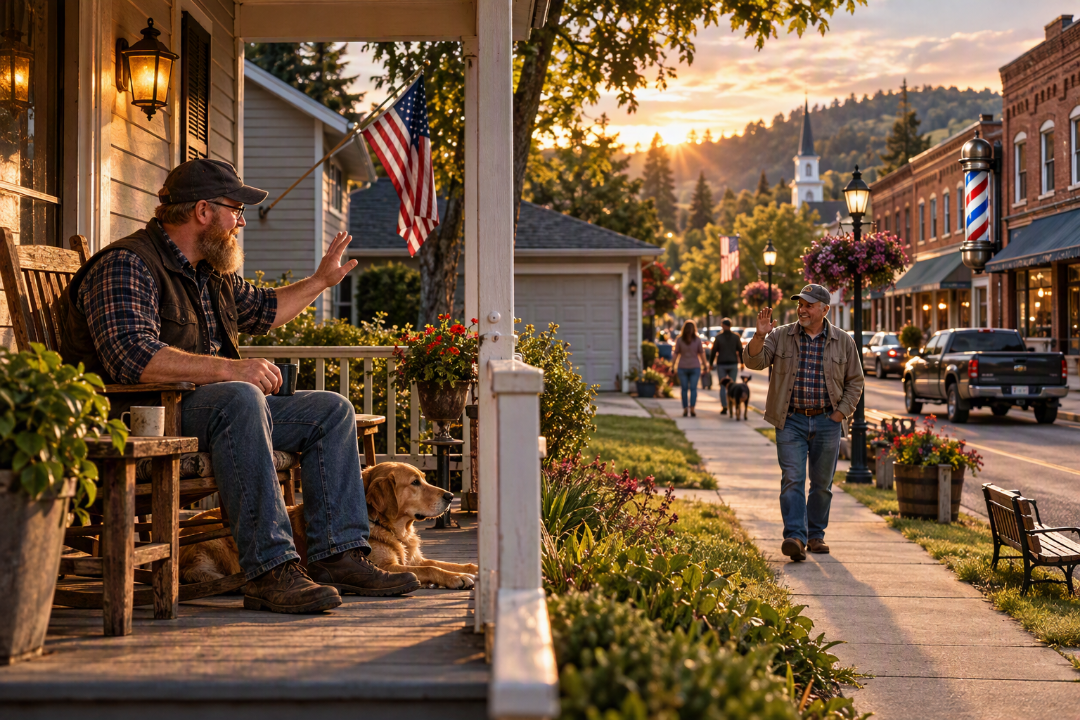
- The Front Porch Early Warning System: Before air conditioning and glowing screens pulled families indoors, the front porch did more social work than almost any other piece of American architecture. Sitting out front meant you were close enough to wave at a passing truck and open enough for a neighbor to lean on the railing and trade local news. A porch light left on signaled welcome, and a banging screen door kept track of the kids. A street where people sit outside is a street that notices immediately when something goes wrong with one of its own.
- The Unwritten Calendar of Showing Up: Main Street earns its keep through a relentless rhythm of small ceremonies that require zero corporate sponsorship. The volunteer fire department polishes the truck for the Fourth of July parade. Neighbors haul sawhorses out to block off a street for a summer block party. Every October, porch lights flick on across the whole town so kids in costumes can knock on strangers’ doors, a level of voluntary neighborhood trust that only works when adults still hold the line. Every December, half the town stands in the cold just to watch the mayor plug in an extension cord for the tree lighting.
- The Fifty-Cent Rehearsal: Even the folding table lemonade stand on a hot Saturday afternoon is a serious piece of cultural training. The kid behind the hand-lettered sign is not making a real profit once you count the cost of the lemons. They are getting their first rehearsal in looking an adult in the eye, making something with their own hands, and acting as a visible member of a neighborhood.
Even the roadside water towers proclaiming a two-stoplight town the “Buckle of the Corn Belt” or home to the “World’s Largest” frying pan are not jokes to the people who maintain them. They are proof that a community with limited resources can still decide, on purpose, that the place they live is worth defending and worth being proud of out loud.
The Actionable Perimeter
A town does not forget what a town is for all at once. It forgets one closed garage door and one skipped Saturday at a time. Reclaim the ground in front of your own house today.
- Sit on the front side of your house tonight. Take your coffee or your iced tea out to the front porch or the front steps for thirty minutes before sundown instead of retreating to the back deck or the living room couch. Leave the phone inside. Wave at every car that passes and talk to whoever walks by on the sidewalk.
- Stop driving past the fifty-cent table. The next time you pass a kid running a lemonade stand or a local youth crew washing cars in a hardware store parking lot, pull the truck over. Keep five-dollar bills in your console specifically for it. Look the kid in the eye, shake their hand, and overpay for the cup.
- Shift one purchase back to Main Street this week. Before you click a button to ship a box from a warehouse three states away, walk into the local hardware store, the family diner, or the independent auto shop with the founder’s name still painted on the glass. Spend your money with the men and women who actually pay for the little league jerseys in your zip code.
Ready to put structure behind your daily walk? Grab the 30-day field guide workbook here: https://aconversationwithdad.gumroad.com/l/vogof


Leave a Reply