
Sit through enough corporate product launches over twenty-five years and you learn how much money gets burned trying to manufacture authenticity from the top down. Executives hire branding agencies, rent out hotel ballrooms, and spend six figures on focus groups to force people to care about a product that has zero soul behind it. Six months later, the campaign is dead and nobody remembers the slogan. Meanwhile, the real culture that actually holds a house together is never engineered in a boardroom. It gets built on the back porch by people who were not trying to get famous and never waited for an institution to hand them a microphone.
A man who waits for a polished stage before he passes down what matters is leaving his kids with nothing but static.
The Blueprint: The Hollow Square and the Bristol Sessions
In Colossians 3:16, Paul gives the early church a ground-level instruction on how a community keeps its spine straight: “Let the message of Christ dwell among you richly as you teach and admonish one another with all wisdom through psalms, hymns, and songs from the Spirit, singing to God with gratitude in your hearts.” Notice there is no mention of a paid performance crew or a stage. The people in the room were expected to carry the weight of the song themselves.
Two hundred years ago on the American frontier, clapboard churches had a practical problem. Hymnals were scarce, sheet music was expensive, and plenty of hard-working farmers could not read a note on a page. They did not cancel the service and wait for a government grant. They improvised, and out of that grit came the entire foundation of American roots music:
- Lining Out and Call-and-Response: Preachers and song leaders chanted a single line of a hymn, and the congregation roared it back. When English congregational singing collided with West African musical traditions on American soil, that call-and-response architecture turned listeners into active participants. It became the underground river feeding gospel, blues, soul, and country music.
- The Hollow Square of Sacred Harp: To solve the literacy hurdle on the frontier, itinerant singing teachers assigned geometric shapes like triangles, circles, squares, and diamonds to the notes of the scale. Published in Georgia in 1844, The Sacred Harp let ordinary farm families harmonize in four parts at a glance. Singers still sit in a hollow square facing inward toward one another rather than outward toward an audience, because the singing was never meant to be a show.
- Bill Monroe and the Kentucky Coal Camps: Born on a Kentucky farm in 1911, Bill Monroe absorbed old Scottish and Irish fiddle tunes alongside the syncopated blues phrasing of a local Black guitarist and coal miner named Arnold Shultz. Monroe forged those strands into the hard-driving, mandolin-led sound of his Blue Grass Boys, earning the very first encore on the Grand Ole Opry in 1939 with “Mule Skinner Blues” and guarding the standard of bluegrass for nearly sixty years.
- The Carter Family and the Three-Continent Porch: In the summer of 1927, A. P. Carter, his wife Sara, and Maybelle Carter traveled out of the Virginia mountains to Bristol, Tennessee, and recorded the foundational songbook of country music. A. P. collected ancient mountain ballads alongside Black guitarist Lesley Riddle, while Maybelle’s thumb-and-finger guitar style became the blueprint for generations of pickers. Put a European fiddle, an African-descended five-string banjo, and a mail-order guitar on the same porch with gospel harmony, and you have the exact sound of American endurance.
When WSM began broadcasting the Grand Ole Opry out of Nashville in 1925, it did not invent that culture. It simply threw a fifty-thousand-watt switch on a tradition that rural families had already been tending in church pews, camp meetings, and barn dances for over a century.
The Actionable Perimeter
Tradition does not survive because people buy tickets to watch professionals perform it. It survives when fathers and mothers make it part of the furniture inside their own four walls.
- Kill the background static in your truck. Stop letting talk-radio outrage or algorithmic pop fill every quiet minute of your commute. Put on a record with actual roots behind it this week, whether it is the Carter Family, Bill Monroe, or Johnny Cash, and let your kids hear music played by human hands on real wood and steel.
- Sing out loud in the pew. The next time you are standing in church with your family, drop the self-conscious mumble. Square your shoulders and sing the hymn out loud, even if your voice is rough around the edges. Your sons need to see that a grown man is not embarrassed to raise his voice in gratitude.
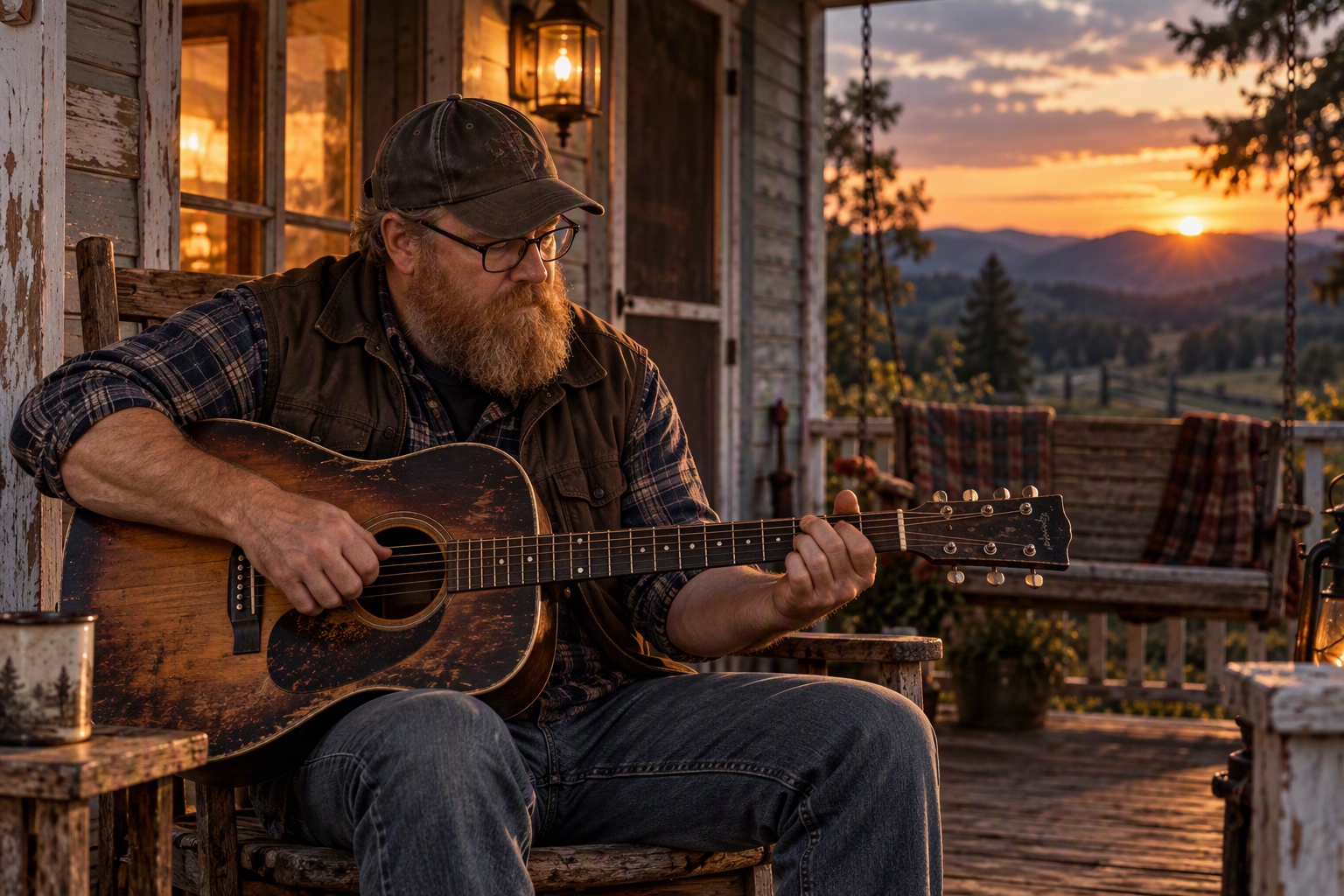
- Put a real instrument in the house. You do not need a conservatory degree to pass down a craft. Pick up a secondhand acoustic guitar or a mandolin from a local shop, leave it on a stand in the living room instead of locked in a closet, and learn three chords alongside your kid before the month is out.
Ready to put structure behind your daily walk? Grab the 30-day field guide workbook here: https://aconversationwithdad.gumroad.com/l/vogof
Leave a Reply