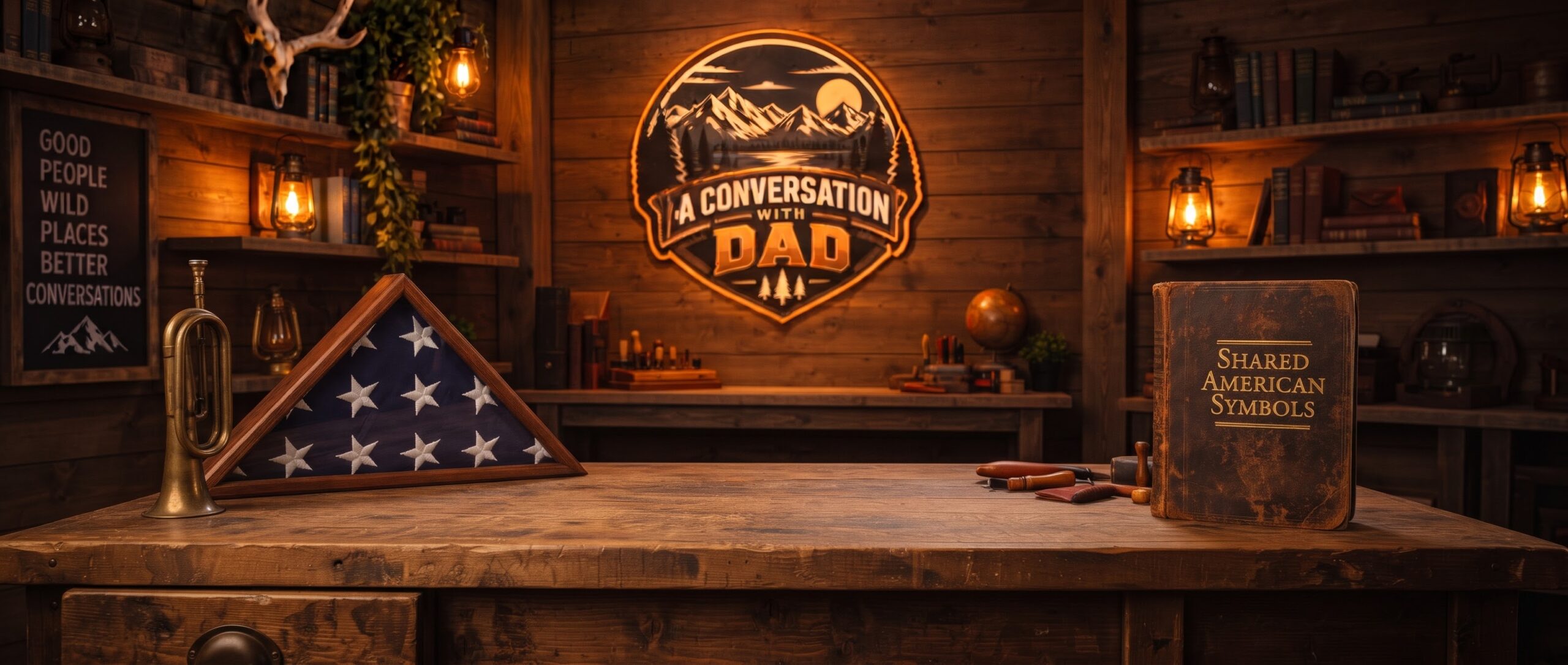
Folded Thirteen Times: Why Shared Symbols Hold the Line When Talk Is Cheap
In twenty-five years of closing corporate enterprise deals, I learned that a company’s mission statement painted on the lobby wall means nothing. If you want to know whether an organization actually has a spine, you watch how the crew treats the equipment on the loading dock and whether the bosses honor the contracts signed by the men who came before them. Today, it is fashionable for comfortable people to sneer at national symbols as outdated pieces of cloth, while taking every bit of the security bought beneath that cloth for granted.
A man who is too cynical to stand at attention for the people who paid his tab has forgotten the price of his own peace.
The Blueprint: The Twelve Stones at the Jordan and Fort McHenry
When Joshua led Israel across the Jordan River, he did not trust the next generation to remember the crossing on good intentions alone. In Joshua 4:6, he ordered twelve men to haul heavy stones out of the riverbed and stack them on the bank as a permanent marker: “In the future, when your children ask you, ‘What do these stones mean?’ tell them that the flow of the Jordan was cut off before the ark of the covenant of the Lord.”
Human beings leak memory fast. Without physical anchors and repeated discipline, a household forgets what it cost to build the roof over its head within two generations.
America never had the luxury that older nations lean on. We do not have a single shared ethnicity, a single ancestral bloodline, or a thousand years of continuous history to bind us together. From June 14, 1777, when the Continental Congress resolved that thirteen stripes and thirteen white stars on a blue field would represent a new constellation, this republic has had to build its unity out of shared oaths and visible discipline. Even the legend of Betsy Ross, a real Philadelphia upholsterer who made ship colors for the Pennsylvania Navy while Francis Hopkinson drafted early designs for Congress, endures because Americans recognized that the banner belonged to working hands, not a royal house.
Look at the real muscle memory built around that banner over two and a half centuries:
- The Dawn at Fort McHenry: In 1813, Baltimore flagmaker Mary Pickersgill stitched a thirty-by-forty-two-foot banner for Fort McHenry. A year later, lawyer Francis Scott Key stood on a ship anchored miles away through a night of British naval bombardment, waiting to see if the fort had fallen. When Pickersgill’s battered flag was still flying at daybreak, Key wrote the lines that became our national anthem. It is notoriously tough to sing, yet forty thousand strangers in a stadium still take off their caps, put a hand over their hearts, and carry that tune together.
- The Unbroken Watch at Arlington: Established in 1864 on the grounds of a former Confederate estate so the land could never again be used as a plantation, Arlington National Cemetery holds the nation’s dead in rows of white stone. At the Tomb of the Unknown Soldier, sentinels from the Army’s Third Infantry Regiment march twenty-one steps, pause for twenty-one seconds, and turn, twenty-four hours a day, 365 days a year. When Hurricane Sandy slammed the East Coast in 2012, those guards refused shelter and held their post in the driving storm.
- Waterloo and the Twenty-Four Notes of Taps: In 1865, a small-town druggist named Henry Welles in Waterloo, New York, pointed out that while towns were praising living veterans, someone needed to put flowers on the graves of the dead. By May 1866, the entire village closed its shops and marched to the cemetery, launching what became Memorial Day. At those gravesides, a single bugler plays Taps, the twenty-four-note call adapted by Union General Daniel Butterfield in 1862 that proved so fitting both Union and Confederate soldiers adopted it to bury their dead.
- The Thirteen Folds: Under the Flag Code codified in 1942, the flag never touches the dirt, is lit if flown in the dark, and is retired by fire through groups like the American Legion and the Scouts rather than tossed in the trash. At a veteran’s burial, a casket flag is folded thirteen times into a tight triangle, stars facing out, and handed to the next of kin with the gratitude of the nation.
A kid whose grandparents arrived from Vietnam, a kid whose ancestors arrived in chains, and a kid whose family has farmed Ohio dirt since the Revolution can all stand in the same high school gym on a Monday morning, put a hand over their heart, and mean the exact same thing. That is not empty pageantry. That is the perimeter line of a free people.
The Actionable Perimeter
- Check the halyard on your own porch. Step outside before sundown and look at the flag flying on your house or in your yard. If the edges are frayed or faded, take it down tonight, buy a fresh American-made replacement, and drop the worn one at your local American Legion post for a proper retirement ceremony. If you fly it after dark, put a dedicated light on it.
- Enforce the posture in the bleachers. The next time you are at a Friday night ballgame or a community event and the opening notes of the anthem start, do not half-stand with your hands in your pockets or keep scrolling on your phone. Take your cap off, square your shoulders toward the flag, and make sure your kids see you standing still until the last note clears.
- Walk the stones before May arrives. Do not wait for a three-day weekend sale to think about the dead. Take your kids to the veteran section of your local cemetery this weekend, read the dates and units carved into five headstones out loud, and explain the difference between Veterans Day for all who served and Memorial Day for those who did not come home.
Handle your business. Guard your house.
Mack here. Stay sharp.
Ready to put structure behind your daily walk? Grab the 30-day field guide workbook here: https://aconversationwithdad.gumroad.com/l/vogof
Leave a Reply