
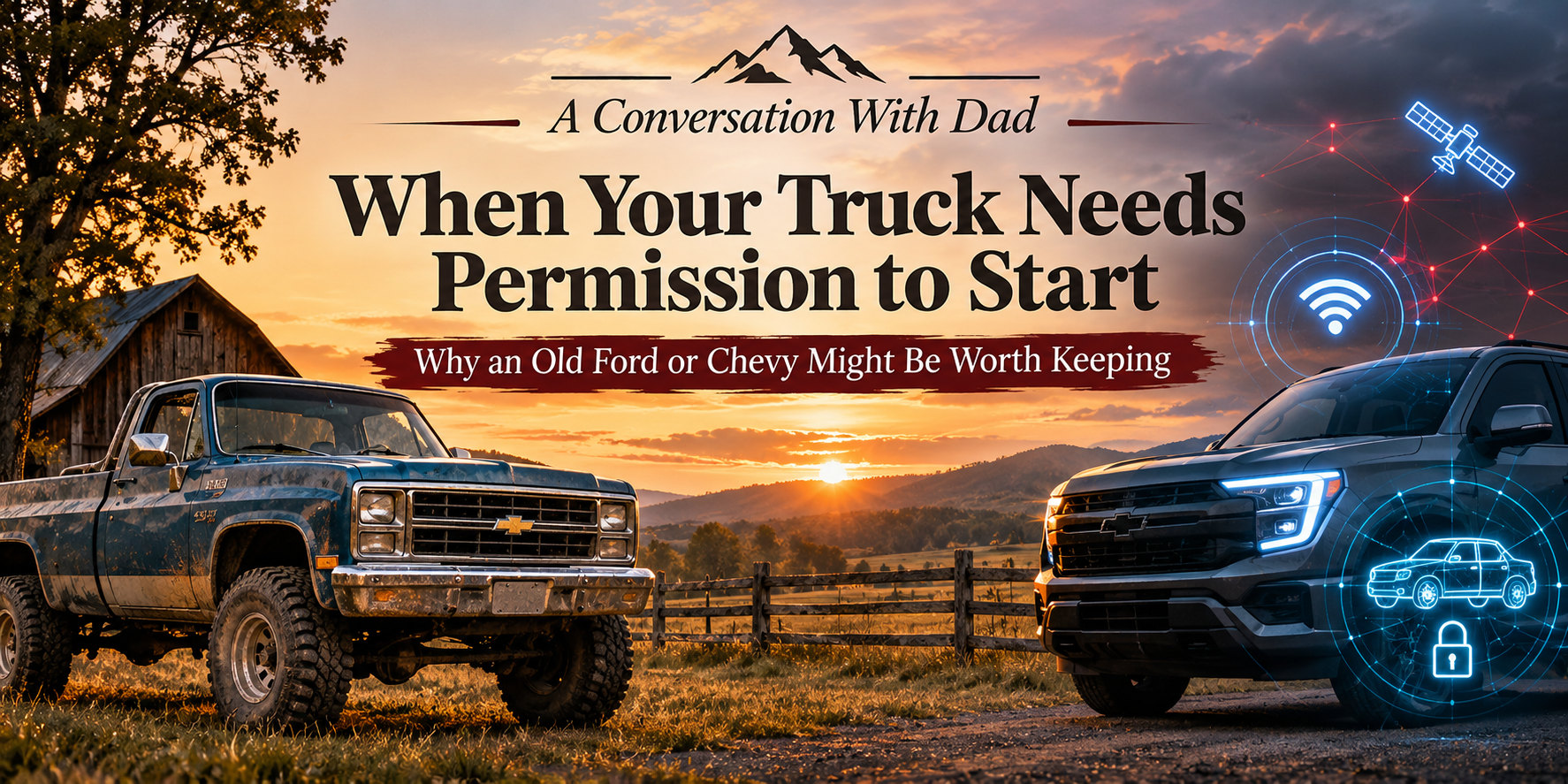
There was a time when owning a truck meant you owned a machine.
You turned the key, the engine started, and you went where you needed to go. If something broke, you could often open the hood, identify the problem, and fix it with a reasonable collection of tools.
Today, we have vehicles that connect to satellites, cellular networks, smartphones, manufacturer servers, and software systems most owners will never understand.
They’re impressive machines. In many ways, they’re safer, cleaner, and more efficient than anything we drove thirty years ago.
But I’ve been thinking about a question.
What happens when the technology we depend on becomes the very thing that makes us vulnerable?
The Vehicle Is Becoming a Computer
Modern vehicles are packed with electronic control systems. Computers manage everything from engine performance to braking, steering assistance, entertainment, and driver-assistance features.
Many also communicate with the outside world.
That connectivity provides real benefits. Emergency assistance, remote diagnostics, security updates, and features that can help prevent accidents.
But every external connection deserves scrutiny.
The federal government has acknowledged that connected vehicles present cybersecurity risks. Researchers have demonstrated remote compromises, and manufacturers have had to address vulnerabilities.
This isn’t science fiction.
What remains uncertain is how widespread or sophisticated a future attack could become.
Now Add Artificial Intelligence
Consider a hypothetical situation.
An advanced, coordinated AI-driven cyberattack targets connected transportation systems across the country.
Instead of attacking one vehicle, the attackers attempt to exploit weaknesses shared by large numbers of vehicles, their service providers, or the infrastructure supporting them.
Imagine the disruption if transportation systems became unreliable at the same time that communications networks or electrical infrastructure were experiencing problems.
Could that happen?
Certain elements are technically plausible. Security researchers have demonstrated vulnerabilities affecting multiple vehicles through shared cloud infrastructure.
But there is no established evidence that an autonomous AI swarm can simply take control of every modern vehicle on the road. Different manufacturers, systems, protections, and vehicle configurations create significant barriers.
Still, the possibility raises a reasonable preparedness question.
Should every vehicle in a household depend on the same kinds of connected technology?
Enter the Old Ford or Chevy 4×4
I’m talking about the older trucks many of us remember.
A Ford F-150 or F-250. A Chevy K1500 or K2500.
A proper four-wheel-drive truck with a conventional drivetrain, a straightforward electrical system, and relatively little technology connecting it to the outside world.
Depending on the year and configuration, these vehicles may have no factory cellular modem, no manufacturer cloud account, and no over-the-air software updates.
That makes them fundamentally different from today’s connected vehicles.
It doesn’t make them invincible.
Older trucks can still have electronic ignition or fuel-injection systems. They can break down, suffer electrical failures, or become stranded without fuel. Aftermarket alarms, trackers, and remote starters can introduce vulnerabilities of their own.
And their age brings serious disadvantages in crash protection, reliability, and emissions.
But a mechanically simpler vehicle with no remote communications hardware eliminates entire categories of remote attack pathways.
That’s worth considering.
The Real Value Is Independence
I don’t believe everyone should trade their modern SUV for a thirty-year-old pickup.
Modern safety features save lives, and there’s a reason vehicle technology has advanced.
But I do believe there’s value in keeping some things simple.
A well-maintained older truck can be useful for hauling supplies, handling rough roads, doing property work, and providing a different transportation option if connected services become unreliable.
The key is understanding what the truck actually depends on.
Can it operate without cellular service? Does it have aftermarket connected equipment? Are its fuel, ignition, and charging systems in good condition?
Those questions matter more than the badge on the grille.
Back on the Porch
Maybe the question isn’t whether new vehicles are better than old vehicles.
In most everyday situations, modern vehicles offer tremendous advantages.
Maybe the better question is whether we’ve become too comfortable building every part of our lives around systems we cannot understand, repair, or control.
I like technology. I see its potential.
But I also believe there’s something to be said for an old American pickup, a set of tools, and knowing how to take care of what you own.
Not because the world is guaranteed to fall apart tomorrow.
Because independence, practical knowledge, and a little redundancy still matter.
And sometimes the smartest machine in the driveway might be the one that doesn’t need to talk to the internet.
Until next time, keep the coffee warm.
Dad
A Conversation With Dad
For a related reflection, read about planning for an extended power outage.
Leave a Reply